Table of Contents
Introduction to the Famous Trango Towers Trek in Pakistan
The trango towers trek stands out as one of the most impressive adventures in northern Pakistan. This journey takes you through the Karakoram range of Pakistan to the base of massive granite spires known for their sheer walls and dramatic shapes. Climbers and trekkers often call the area the Yosemite of Pakistan because of the flawless granite and big wall features.
Trango towers Pakistan include the great trango tower at the center along with the nameless tower nearby. The trek starts from Islamabad, moves to Skardu and follows the Baltoro glacier past peaks like K2, Broad Peak and Gasherbrum. Views open up to towering granite faces that rise straight from the ice. Many people come for the trango towers tour that combines trekking with the chance to see or attempt a trango tower climb.
K2 Trekking and Expedition organizes these trips with local knowledge and support. The path leads to trango tower base camp where the real scale of the trango towers baltoro area becomes clear. Trekkers enjoy breathtaking views of the spire formations and surrounding mountains. This trek suits those ready for remote wilderness and high-altitude conditions.
Why Choose K2 Trekking and Expedition for Your Trango Towers Adventure
K2 Trekking and Expedition handles every part of the trango towers expedition so you can focus on the experience. The team knows the Karakoram well and arranges permits, jeep transport from Skardu to Askole and porters who carry loads along the Braldu river and glacier. Guides stay with the group from Islamabad international airport arrival through the entire trip.
Support includes meals, tents at camps like Paiju and Jhola and help with acclimatisation at key stops. The company uses experienced staff who manage weather conditions and safety on the Baltoro glacier trek. For anyone planning a trango towers tour, this setup makes the journey smoother in a remote part of northern Pakistan.
Trango Towers Height and Key Altitude Details in Pakistan
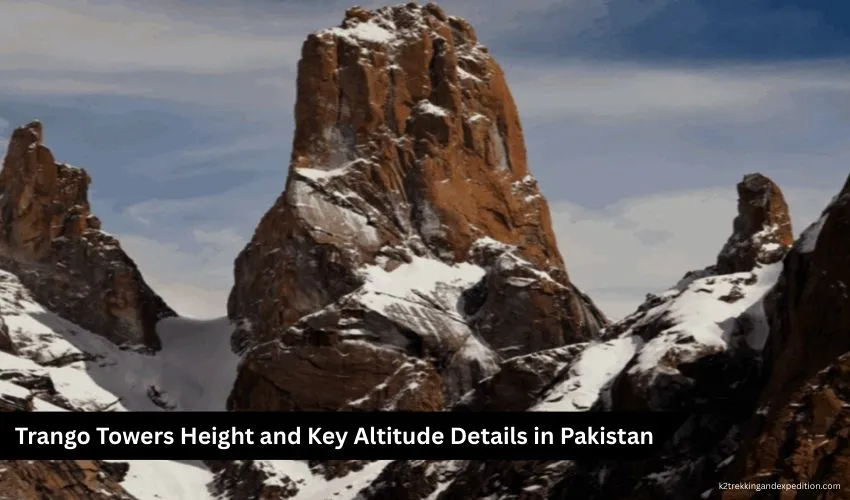
The trango towers height draws attention from climbers worldwide. The great trango tower reaches 6,286 meters (20,623 feet) and stands as the highest in the group. Its east face drops nearly vertically for over 1,300 meters in places.
The nameless tower (also called Trango Tower) sits at 6,239 meters (20,469 feet) and features sharp pointed summits. Trango base camp lies around 4,500 meters where teams set up for climbing or just to enjoy the views. These altitudes demand careful acclimatisation during the trango towers trek.
Here is a quick table of the main heights:
| Peak Name | Height (meters) | Height (feet) | Notable Altitude Feature |
|---|---|---|---|
| Great Trango Tower | 6,286 | 20,623 | Highest point with massive vertical faces |
| Nameless Tower | 6,239 | 20,469 | Iconic pointed spire for big wall routes |
| Trango Base Camp | 4,500 | 14,764 | Starting point for climbing attempts |
These figures show why the area ranks among the most demanding in the Karakoram.
Trango Towers History and Legendary Ascents in the Karakoram Range
Trango towers history begins with early explorations in the Karakoram range of Pakistan. The first major climb came in 1976 when a British team summited the nameless tower. Joe Brown, Mo Anthoine, Martin Boysen and Malcolm Howells reached the top after tough rock and ice sections. In 1977 the great trango tower saw its first ascent by Americans Galen Rowell, John Roskelley, Kim Schmitz, Dennis Hennek and others. They took a route from the west side to the main summit. This opened the area to more big wall attempts.
The 1989 ascent of Eternal Flame on the nameless tower by Germans Kurt Albert, Wolfgang Güllich, Milan Sykora and Christoph Stiegler became famous. They climbed the south-east face with hard free sections and aid. Later teams like the Huber brothers made the first full free ascent in 2009.
Here is a timeline of key events:
| Year | Milestone Event | Notable Climbers or Team |
|---|---|---|
| 1976 | First ascent of Nameless Tower | Joe Brown, Mo Anthoine, Martin Boysen, Malcolm Howells |
| 1977 | First ascent of Great Trango Tower | Galen Rowell, John Roskelley, Kim Schmitz, Dennis Hennek |
| 1989 | First ascent of Eternal Flame route | Kurt Albert, Wolfgang Güllich, Milan Sykora, Christoph Stiegler |
| 2009 | First free ascent of Eternal Flame | Alexander Huber, Thomas Huber |
These ascents built the reputation of trango towers pakistan as a top destination for challenging rock climbing.
Famous Trango Towers Climbing Routes and Technical Details
Trango towers routes attract experienced climbers who want big wall action on granite. The faces offer multi-pitch climbs with cracks, slabs and overhangs. Teams fix ropes and use portaledges for multi-day efforts. The Eternal Flame route on Nameless Trango Tower explained stands as one of the most talked-about lines. It climbs the south-east face for 650 meters with 24 pitches. The route mixes hard free climbing up to 7c+ (around 5.13) and some aid sections on the original line. Weather windows play a big role at this height.
Trango tower east face climbing challenges and history involve massive vertical granite. The east face of great trango drops far and features routes like the Norwegian Buttress from 1984 to the east summit. Climbers face loose rock in places along with exposure. Trango tower climbing grades and difficulty levels range from moderate on easier lines to extreme on the famous faces. Most routes demand prior big wall experience, aid skills and high-altitude fitness. Grades often hit 5.12 to 5.13 with aid ratings like A2 or higher.
Here is a comparison table:
| Route Name | Associated Tower | Difficulty Grade | First Ascent Year | Key Characteristics |
|---|---|---|---|---|
| Eternal Flame | Nameless Tower | 7c+ / 5.13 (free) | 1989 | Iconic south-east face, multi-pitch cracks |
| Norwegian Buttress | Great Trango (East) | High aid/free mix | 1984 | Massive east face, steep granite |
| American Route | Great Trango | 5.11 to 5.12 | 1984 | Northwest ridge, alpine style |
These routes show the technical side of trango tower climb in Pakistan.
Baltoro Glacier Trek Approach to Trango Towers Base Camp from Skardu
The Baltoro glacier trek approach to Trango Towers base camp from Skardu forms the heart of the journey. After a flight or drive to Skardu, a jeep ride heads through Shigar valley to Askole. From there the trek begins along the Braldu river with rocky paths and river crossings. Days pass through camps at Jhola, Paiju and Faqeer Camp as the trail enters the glacier. Moraines and ice sections test legs while views of Paiyu peak and distant K2 appear. The snout of the Baltoro glacier marks the shift to full glacier travel.
As you move towards Trango, the trango towers k2 view opens up with broad peak and other giants in sight. Porters help carry gear across uneven terrain. The final push reaches trango tower base camp at 4,500 meters where the towers rise directly above.
Complete 35-Day Detailed Trango Towers Trek Itinerary Pakistan
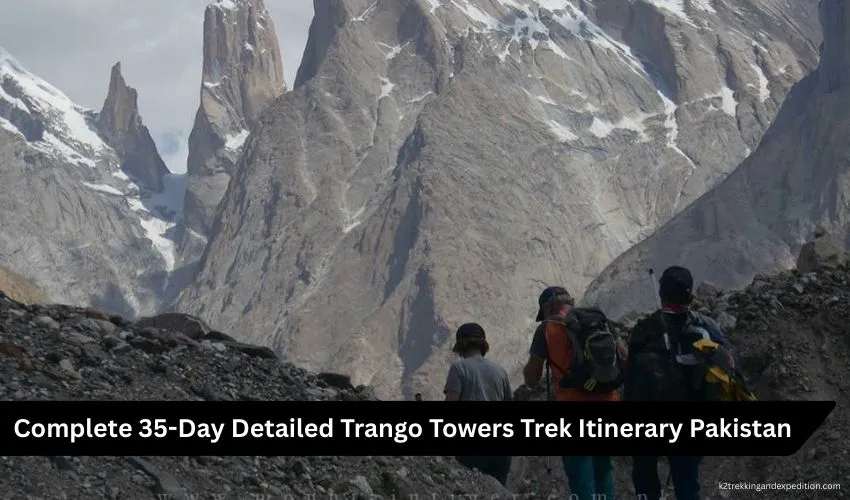
This 35-day detailed Trango Towers trek itinerary Pakistan covers arrival to departure with built-in time for weather and acclimatisation. The plan balances trekking, rest and the climbing phase.
Here is a summary overview table:
| Day Range | Altitude Reached | Main Location | Primary Activity |
|---|---|---|---|
| Days 1–9 | Up to 4,500 m | Islamabad to Trango BC | Trek approach and acclimatisation |
| Days 10–28 | Up to 6,286 m | Trango Base Camp area | Technical climbing and summit attempts |
| Days 29–35 | Down to 540 m | Descent to Islamabad | Trek back and return travel |
Trek Approach and Acclimatization Phase – Days 1 to 9
The first phase focuses on travel and gradual height gain. You arrive in Islamabad and move north quickly.
Day 1 – Arrival in Islamabad
Location: Islamabad. Altitude: 540 m.
Begin your journey by arriving at Islamabad international airport. Transfer to a hotel for rest and a pre-expedition briefing with the Alpine Club of Pakistan. Equipment check and document preparation follow.
Day 2 – Fly or drive to Skardu
Location: Skardu. Altitude: 2,230 m.
Take a scenic flight from Islamabad to Skardu, weather permitting. If the flight is canceled, drive the spectacular Karakoram highway (takes two days). Skardu is the gateway to the Karakoram.
Day 3 – Rest day in Skardu
Location: Skardu. Altitude: 2,230 m.
Final shopping, gear check and acclimatisation. Necessary paperwork for climbing and trekking permits is completed.
Day 4 – Drive to Askole
Location: Askoli. Altitude: 3,000 m.
Drive 6–7 hours by 4×4 jeep through the Shigar and Braldu valleys. Askole is the last village before entering the wilderness. Camp overnight.
Day 5 – Trek to Jhola
Location: Jula. Altitude: 3,200 m.
Begin trekking along the Braldu river. The trail passes over rocky terrain with river crossings. Moderate elevation gain for initial acclimatisation.
Day 6 – Trek to Paiju
Location: Paiju. Altitude: 3,400 m.
Trek continues with views of the Trango towers starting to appear in the distance. Terrain becomes more challenging.
Day 7 – Rest and acclimatisation day at Paiju
Location: Paiju. Altitude: 3,400 m.
Important acclimatisation break. Porters also bake bread and prepare supplies for the glacier portion of the trek.
Day 8 – Rest Day at Faqeer Camp
Location: Faqeer Camp. Altitude: 3,900 m.
After breakfast, we start trekking from Paiju Camp and enter the Baltoro glacier. The route follows rocky moraines and glacier sections with gradual ascents. This is a long but scenic day, offering impressive views of the surrounding Karakoram peaks. Overnight stay at Faqeer Camp in tents.
Day 9 – Trango Base Camp
Location: Base Camp. Altitude: 4,500 m.
Today we continue trekking on the Baltoro glacier toward the spectacular Trango towers. The trail passes over ice and moraine with some uneven terrain. As we approach, the dramatic granite walls of the Trango towers come into full view. By afternoon, we reach Trango base camp, where the climbing phase of the expedition begins. Overnight stay at Trango base camp.
Day 10–28 Trango climbing period
Location: Climbing. Altitude: 6,286 m (20,608 ft).
This period is dedicated to acclimatisation, load carries, route fixing and technical big wall climbing on the trango towers. The team will establish high camps, follow weather windows and make summit attempts as conditions permit. Extra days are reserved for safety and weather contingencies.
This long block allows flexibility for rock climbing on chosen trango towers routes. Climbers work in teams to fix lines and manage high-altitude conditions.
Day 29: Trango Base Camp → Faqeer Camp
Location: Trek. Altitude: 3,900 m. Trek down from Trango base camp to Faqeer Camp. Enjoy glacier and peak views. Overnight stay in tents at Faqeer Camp.
Day 30: Faqeer Camp → Paiju Camp
Location: Trek. Altitude: 3,400 m.
Continue descending along the Baltoro glacier to Paiju Camp. Overnight stay in tents.
Day 31: Paiju Camp → Jula
Location: Trek. Altitude: 3,200 m.
Trek from Paiju to Jula. Cross moraines and suspension bridges. Overnight stay in tents.
Day 32: Jula → Askole
Location: Trek. Altitude: 3,000 m.
Final trek leg to Askole, the starting point of the Baltoro glacier trek. Overnight stay in tents or local lodges.
Day 33: Askole → Skardu (By Jeep)
Location: Jeep.
Altitude: 2,230 m. Jeep drive through Shigar valley back to Skardu. Rest and overnight stay in hotel.
Day 34: Skardu → Islamabad (By Flight)
Location: Flight. Altitude: 540 m.
Fly from Skardu to Islamabad (weather permitting). Transfer to hotel and free time for rest or sightseeing.
Day 35: Departure From Islamabad
Location: Jeep. Altitude: 540 m.
Transfer to airport for international departure. Expedition ends.
For more on similar routes see the K2 Base Camp Trek on the site.
Stunning Trango Towers Photos and Iconic K2 Views During the Trek
Trango towers photos capture the scale of granite walls against blue skies and ice. Many shots show the great trango and nameless tower rising from the glacier with sharp spires catching light. During the trango towers trek the trango towers k2 view rewards every step. From higher points near Concordia or base camp you spot K2 in the distance framed by other peaks. These scenes make the effort worthwhile.
Trekkers often pause at Paiju or along the glacier for photos of the towers against the horizon. The light changes throughout the day and adds drama to every frame.
Rock Climbing Experience on Trango Towers in Northern Pakistan
Rock climbing on Trango towers in northern Pakistan tests skills on world-class granite. The big wall style requires multi-pitch work, crack techniques and endurance at altitude. Climbers deal with challenging rock climbing where pitches demand precision. Weather can shift fast so teams watch forecasts closely. The trango tower expedition combines rock and ice climbing elements on the approach and routes.
Many describe it as one of the finest big wall areas anywhere. The isolation and scale create a special atmosphere for those who reach the faces.
Frequently Asked Questions
1. What is the Trango Towers trek?
The trango towers trek takes you deep into the Karakoram mountains of Pakistan to see the famous granite spires up close. You walk along the Baltoro glacier past K2 and Broad Peak until you reach base camp below the Great Trango Tower and Nameless Tower. The path starts from Skardu after a jeep ride to Askole and offers stunning glacier views and massive rock faces. Many people do this trek just for the scenery while others combine it with climbing attempts.
2. Is the Trango Towers trek safe?
Safety on the trango towers trek stays good when you travel with experienced local teams who know the glacier routes well. Porters carry heavy loads and guides handle river crossings plus weather changes. Altitude sickness remains the main concern above 4000 meters so slow pacing and rest days help a lot. Helicopter rescue exists in serious cases though weather sometimes delays it. Overall groups report few major problems when prepared properly.
3. Are Trango Towers trek difficult?
Yes the trango towers trek counts as difficult because of long walking days on uneven moraine and ice plus river crossings early on. You gain altitude steadily from 3000 meters to 4500 meters at base camp which tests stamina. The approach phase lasts about nine days with some tiring sections near Paiju and Faqeer Camp. Climbers find the glacier part demanding but rewarding once the towers appear.
4. How long does the Trango Towers trek take?
The full trango towers trek usually runs 35 days from arrival in Islamabad back to departure. The approach trek to base camp takes around nine days while descent needs another six or seven days. The middle block of 19 days allows climbing attempts or rest depending on weather. Shorter versions exist but most packages plan 30 to 40 days total to cover delays.
5. What is the best season for Trango Towers trek or climbing?
Mid-June through early September works best for the trango towers trek and any climbing. These months bring stable weather fewer storms and clearer views of the granite faces. Snow covers the glacier less in July and August so trails stay easier to follow. Avoid early season because heavy snow blocks paths and late September risks sudden cold snaps.
6. Is the Trango Tower Expedition suitable for beginners?
No the trango towers expedition does not suit beginners at all. The technical big wall routes demand years of rock climbing experience plus prior high-altitude trips. Even the trek approach requires strong fitness for glacier travel and heavy packs. Beginners should start with easier treks like K2 base camp before thinking about Trango.
7. How fit do I need to be for the Trango Towers trek or expedition?
You need solid fitness for the trango towers trek with regular cardio hiking and strength training in the months before. Trekkers carry day packs for eight to ten hours on rough ground while climbers handle load carries up steep faces. Good lung capacity helps at altitude and leg strength matters on moraine. Most people train by walking hills with weight to match the demands.
8. What are the risks of climbing Trango Towers?
Climbing the Trango Towers brings risks like rockfall on loose granite sections plus falls on exposed pitches. Altitude sickness hits hard above 5000 meters and sudden storms trap teams on walls. Crevasses exist on the glacier approach and weather windows close fast. Experienced climbers manage these with careful planning and good route choice.
9. How do I prepare for the Trango Towers trek?
Start preparing for the trango towers trek by building endurance with long hikes and backpacking trips. Check gear like sturdy boots crampons and warm layers early. Get a medical check and talk to your doctor about altitude meds if needed. Join a group with K2 Trekking and Expedition for permit help and porter support.
10. What is the best time of year to do the Trango Towers trek in Pakistan?
July and August stand out as the best months for the trango towers trek in Pakistan. Temperatures stay comfortable on the glacier routes and skies clear for great photos of the towers. Crowds remain low compared to other areas and flights to Skardu run more reliably. Plan around these peak weeks for smoother travel and better conditions.
Conclusion – Planning Your Trango Towers Trek Adventure in Pakistan
The trango towers trek offers a rare mix of trekking through the Baltoro glacier and views of legendary granite towers in the Karakoram. From the approach past Askole and Paiju to time at trango tower base camp, the journey stays memorable. Whether you trek for the scenery or aim for a trango towers expedition, the experience stands apart in Pakistan. The 35-day plan gives room for safety and enjoyment.
If this adventure interests you, reach out to K2 Trekking and Expedition. They can answer questions and help plan your trip. Contact them today at +92 342 8394603 or info@k2trekkingandexpedition.com to get started. The towers wait in the Karakoram range of Pakistan.